
In the movie “Finding Forrester,” William Forrester, portrayed by Sean Connery, imparts a piece of wisdom to his newfound protégé, Jamal Wallace: “The first key to writing is to write, not to think.”
Although I don’t work in a university writing center, and I’m definitely not the go-to person for the intricacies of writing like grammar and structure, I find it difficult to untangle writing from my job. As a librarian tasked with teaching students to become competent researchers, writing inevitably weaves into the conversation. So, breaking my usual stance, here’s a piece of straightforward writing advice: Write first. Think later.
Commonly, we aim to construct our research paper arguments on the foundation of evidence we discover. This evidence comes from books, scholarly articles, and other sources. Skipping the research step leads us to simply write our beliefs and then retroactively find evidence to back it them up, which is the antithesis of good research.
Embracing the “write now, think later” mantra doesn’t mean skipping the step of robust research. Here are some essentials if you’re embarking on a research essay or study:
- Craft a solid research question: It’s okay to refine this as you delve deeper. Often, we find our essay answering a somewhat different question than initially intended, so tweaking the question—and consequently our thesis—during the final edit is common.
- Theme your research question or thesis: Jot down the question at the center of a page or on a whiteboard. (Increasingly, I’ve noticed, students or faculty use an iPad wit ha stylus for this task.). Then, develop a mind map from it, populating with related terms, synonyms, and everything you know about the topic. Group what emerges into themes. These themes will help you later.
- Dig into some preliminary research: You’ll want to ensure you’ve got enough vocabulary to unearth published materials. As a librarian, I’m all about “finding the stuff” rather than the “stuff.” There’s always the possibility of missing a crucial term or phrase, and I always assume that there’s a critical piece of jargon I could be missing. Learning the language of the discipline and the topic is imperative, and you want to add new terminology to the mind map as you go.
- Using my existing knowledge, I scout out a few credible sources to steer me toward the answer to my question. I make notes on these sources. This is where the writing starts.
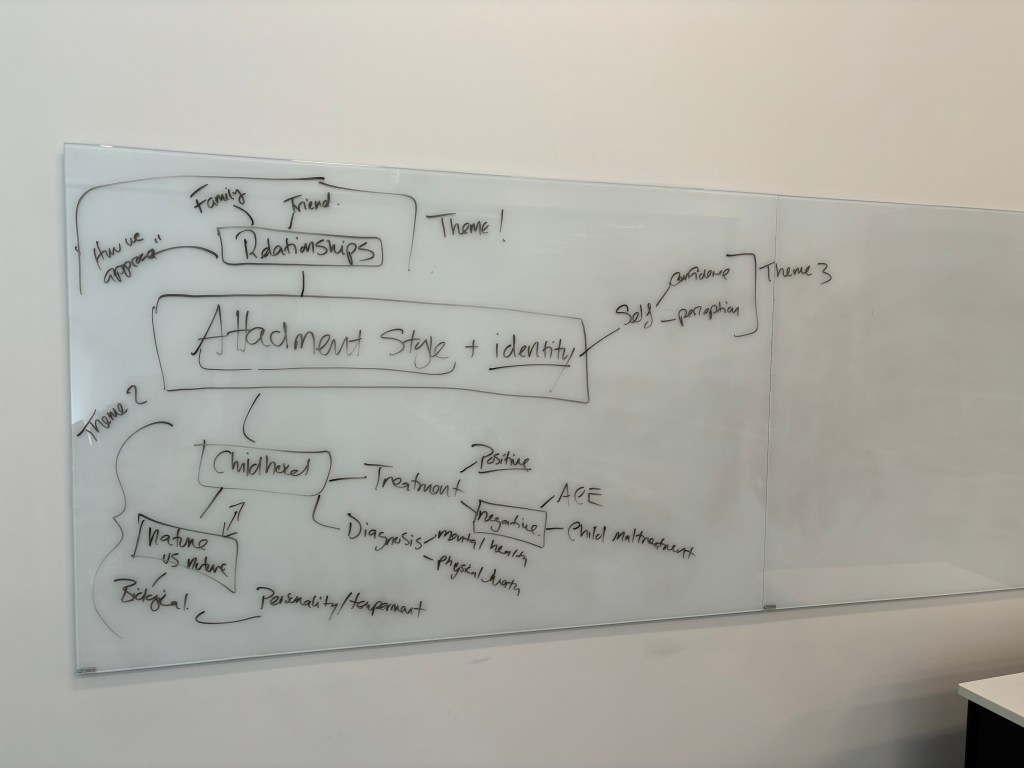
None of these steps should exceed an hour. Impose a time limit on your initial research. It’s critical to begin writing soon.
Start by writing summaries of your sources and reflecting on them—their validity, their arguments, etc. Get your ideas about the topic down as soon as you can. While many (if not most) of you initial ideas will not make it into your final piece, the purpose of writing soon is to stimulate your writing flow. Start writing! When you see even a few paragraphs forming, you’ll feel more inspired. Suddenly, you’ve created something, and you’ve conquered the daunting “blank page effect.”
Research is critical, but circle back to it only after you’ve got some words down. Author Steven Pressfield, in his book Do the Work, argues that research can quickly become a form of “resistance.” Resistance is that internal force that blocks us from our work, telling us we’re inadequate, too tired, or that tomorrow is a better day to start. It’s implacible, always devising reasons to delay the writing process. If you front-load the research, it can turn into resistence.
Remember, resistance plagues everyone. Besides death and taxes—those inevitable elements Shakespeare talked about—resistance hounds us relentlessly. It’s a daily battle. This morning, for instance, I was determined to finish this blog post, but resistance whispered that I should check my email first. Creating takes precedence because there will always be more emails, voicemails, iMessages, social updates— distractions.
So, for anyone out there with grand ideas staring at a blank page: Just write!
“No thinking – that comes later. You must write your first draft with your heart. You rewrite with your head.”
William Forrester, Finding Forrester (2000)
 Erik Christiansen
Leave a comment