
As a technology enthusiast, it pains me to think back and remember when some technologies were simpler.
During my summer vacation, I’ve been simplifying my life. This has involved going through my belongings, selling and donating items I no longer use, and organizing what I keep. “Summer cleaning” is a ritual for me, though this year I extended the project to the digital realm.
If you’ve read any of my other posts on note-taking and organization, it might surprise you that even I need to review my computer files and processes periodically. I need to add proper tags to these files and organize them. Subscriptions and apps also tend to accumulate, as I frequently test software tools for productivity. This summer, I started thinking more critically about the complexity of our digital lives. Despite all the conveniences, there’s a case to be made that some of today’s technology is more complicated than what we had before. Of course, there are nuisances we no longer deal with. For instance, interoperability between platforms has drastically improved (does anyone remember using a Mac in the 1990s?). But in some respects, we’ve taken a step back.
Originally, I intended this to be one article, but I decided to split it up since I’ve already hit three thousand words. I plan to release this series, examining specific technologies that unnecessarily complicate our lives and offering steps users can take to reclaim simplicity.
Subscription Creep
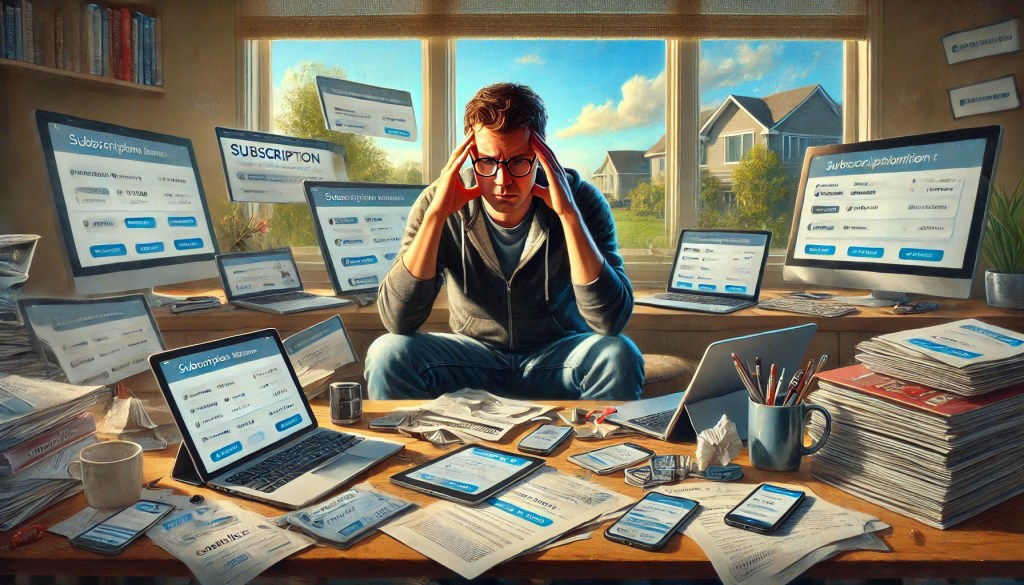
Today, I’m going to talk about subscriptions—the recurring costs that keep stacking up.
Companies love subscription models because they provide dependable, recurring revenue. I can’t fault them for pursuing this business model. However, for us users, it can add layers of complexity to our digital lives. I see five major problems with everything moving toward subscriptions.
1. Accumulation of Subscriptions
There’s a “subscription creep” happening—the unintentional buildup of subscription services. According to CNET, the average U.S. consumer spends approximately $1,000 annually on subscriptions, including video streaming, music streaming, e-commerce (like Amazon Prime), digital tools, groceries, and more. An article from Computer World estimates that US consumers people spend an average of $273 per month (or $3200 annually); that’s up 15% since 2018. If you’re not paying close attention to your credit card statements, these recurring charges can add up, both monthly and annually.
2. Complex Subscription Models
Subscriptions aren’t as straightforward as they used to be. Many now come with hidden expenses, like additional fees for premium content or higher-tier services, leading to unexpected charges on your credit card. Take Netflix, for example. It used to have a single tier, but now there are several. With Netflix’s crackdown on password sharing for those outside the same household, the service has become even more complicated. If you’re like me, you now have to manage multiple households.
Cancelling subscriptions isn’t always easy either. For example, to manage subscriptions through the Apple App Store on my Mac, I had to open the App Store, go to Account Settings, click Manage, then click Subscriptions, and click Manage again. Only then did I reach the page showing what I was paying for? This menu structure might be a result of the App Store’s design, but I can easily imagine users getting frustrated, being unable to find their subscriptions, and simply giving up—continuing to pay for something they no longer want. (On the iPhone and iPad, this process is, admittedly, a little simpler: you open Settings, tap your iCloud profile and select Subscriptions. Still, if you didn’t know to look there, how easily would you find it?)
3. Reduction in User Control and Ownership
There’s also a reduction in user control when it comes to software subscriptions. Users are dependent on the company to maintain access and may face issues if they stop paying for the subscription. For example, if you cancel your Adobe subscription, your Photoshop files don’t disappear unless you’ve saved them exclusively in their cloud. However, in the mobile space, content is often locked within the app. When you stop paying, this content becomes inaccessible or difficult to export.
Back when we purchased software once and had perpetual access, this wasn’t a problem. There was no need to manage subscriptions and keep track of recurring costs. Life was simpler.
4. Diluted Value from Subscription Overload
As you accumulate more subscriptions, the value of each one diminishes. Have you ever sat down to watch a show on your TV and found yourself confronted by multiple streaming services with seemingly endless content options? This is the cable TV problem all over again, except now we flip through apps instead of channels. This paralysis of choice—having too many options—makes it hard to prioritize our entertainment. Faced with a flood of choices, we often default to what we’re used to—our favourites. We can’t watch every show on every service, play every game on Xbox Game Pass, or listen to all the music on Spotify. We end up consuming a small fraction of that content and relying on recommendation algorithms to decide what to watch, play, or listen to.
Sometimes, it feels like everything is a shuffled playlist. Streaming services encourage binge-watching by auto playing the next episode. The iTunes Store shifted us to a model of individual song purchases (arguably forcing albums to improve), while Spotify moved everyone toward playlist culture. Game streaming has led us to sample games rather than finish them, always moving on to the next thing. An argument could be made that our attention has suffered as a result of our media subscriptions.
On the software side, subscriptions promise ongoing support and feature updates. But do we really need those features? The tools I use in Microsoft Word or Excel probably haven’t changed much since the early 2000s. Yet, in a software subscription model, I’m paying for features whether I use them or not.
5. Potential Innovation Stagnation
The subscription model could lead to a lack of innovation. If I’m already paying monthly or annually for a service, the company is only motivated to do just enough to keep me subscribed. As I mentioned earlier, in this model, I’m paying for software whether or not I use the new features.
The app subscription trend might have other consequences. If Forbes is correct that there’s a movement to unsubscribe, it could push users toward default apps on their devices and accept their limitations. The power of the default is strong. Companies often “Sherlock” apps by incorporating features from independent developers into default offerings. Apple is famous for this—and you only have to look at the newest features added to the Notes and Reminders apps and see how they’ve incorporated features from competitors.
Solutions and Recommendations
Despite potential vulnerabilities in the subscription business model, I doubt subscriptions will ever go away. But we might see a rebalancing among consumers. Here are some things you can do to reduce your subscription burden.
- Cancel Redundant Services: Start by cancelling redundant services. While reading about subscription costs, I came across a funny Reddit thread where someone listed all their monthly subscriptions. While I don’t endorse piracy, many of the other comments offered insightful suggestions. Years ago, my wife transformed how I think about costs. Instead of just focusing on the total dollar amount, she advised me to consider the cost-per-use. High-cost-per-use services are the ones we can do without.
- Audit Subscriptions Regularly: Regularly audit your subscriptions and cancel any that are unnecessary. Tools like subscription managers can help track active subscriptions.
- Consider Open-Source Software: Explore open-source software that is free and provides similar functionality to subscription-based alternatives. I’m a Microsoft 365 Subscriber, but Libre Office is a great alternative.
- Prioritize One-Time Purchase Options: Whenever possible, seek out software and services that offer one-time purchase options. Maybe purchasing some media or software outright is more expensive up front, it will likely save money and headaches in the future because there are no recurrent costs. Where possible, I’m purchasing software and media outright (in digital format), and cancelling all but the most essential services.
 Erik Christiansen
Leave a comment